
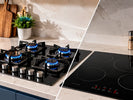
Gas vs. Electric Hobs: Which One Is Right for Your Kitchen?
2 min reading time
2 min reading time
Gas or electric hob? Discover the key differences in cooking performance, safety, cleaning, and installation to choose the perfect hob for your kitchen.
Whether you are upgrading your kitchen or planning a new built-in setup, the hob is one of the appliances you will use most. Gas and electric models can both be excellent choices, but they offer different cooking experiences. Here is what to consider before buying.
Gas hobs use visible flames, allowing you to see changes in heat immediately. Many home cooks like this familiar style, especially when switching quickly between high and low heat.
However, gas hobs generally have more burner parts and pan supports to clean. Installation needs a suitable gas supply and should be carried out by a qualified professional. Good kitchen ventilation is important when cooking with gas.
Electric hobs include different technologies. Traditional solid-plate models use heated metal plates. Ceramic radiant hobs have a smooth glass-ceramic surface with heating elements underneath. Induction hobs also have a smooth surface, but heat compatible cookware through a magnetic field.
That distinction matters: induction is electric, but not every electric hob is induction. Do not assume a ceramic hob has induction features unless the specifications explicitly say so.
Smooth ceramic and induction surfaces are generally easy to wipe down once it is safe to do so, while gas hobs require cleaning around burners and pan supports. Spills can burn onto hot radiant ceramic surfaces, so follow the manufacturer’s care instructions.
Induction cooking surfaces can still become hot from the cookware resting on them. Always treat the hob as hot until its indicators show it is safe.
Gas hobs need appropriate cookware and safe gas connections. Radiant ceramic models work with many flat-bottomed pans suitable for electric cooking. Induction models need induction-compatible magnetic cookware.
For a built-in hob, check the cut-out dimensions, electrical supply or gas connection, and ventilation clearances. Safety features such as flame-failure protection, child lock or residual-heat indicators differ from one product to another.
Compare the exact product specifications rather than choosing by appearance alone. The right hob should match your kitchen layout, utilities, and cooking habits.